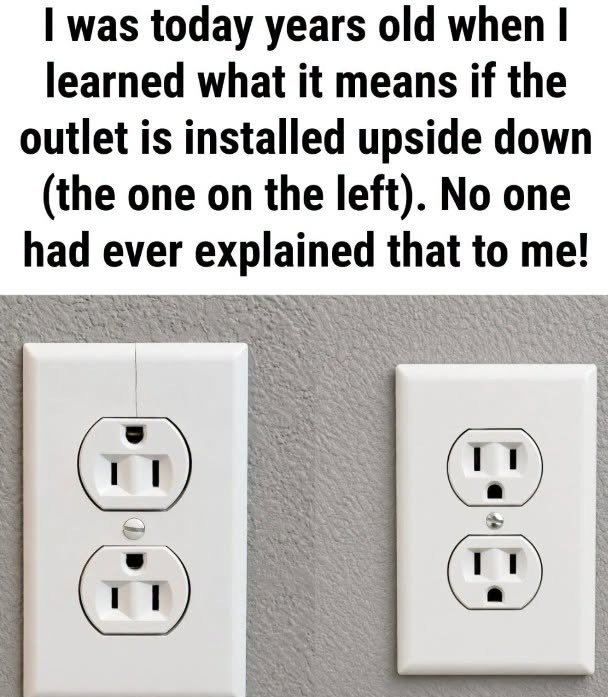
Have you ever walked into a room and noticed that one electrical outlet looks like it’s installed upside down?
t first, it can seem like an obvious mistake. After all, most wall outlets have the two narrow slots on top and the larger ground opening below. So why would an electrician deliberately install one the other way around?
The surprising answer is that there isn’t always one universal “correct” orientation.
In many cases, an upside-down receptacle is intentional—and it can serve a practical purpose.
What Does “Upside Down” Actually Mean?
A typical North American electrical receptacle has three openings:
Two vertical slots for the electrical blades
A round or U-shaped opening for the grounding connection
Many people are accustomed to seeing the grounding hole at the bottom.
But electrical receptacles can often be installed with the grounding opening at the top instead.
That doesn’t automatically mean the receptacle is wired incorrectly.
The orientation of the physical outlet and the way it is electrically connected are separate issues.
Why Would an Electrician Install It That Way?
One common reason is safety in certain environments, particularly where a plug could be pulled or partially dislodged.
Imagine a device with a heavy plug or cord connected to the receptacle.
If the grounding opening is at the top and a metal object were to fall against a partially inserted plug, the configuration may reduce the chance of creating a dangerous electrical path in some circumstances.
More commonly, however, an unusual orientation can serve as a visual signal.
Upside-Down Outlets Can Be Used as a Visual Indicator
In some buildings, receptacle orientation is used to communicate something about the circuit.
For example, an electrician may install a receptacle differently to indicate that it is connected to a particular type of circuit, such as a switched circuit or a circuit with special characteristics.
This isn’t a universal rule, though.
You shouldn’t assume that every upside-down receptacle has a special electrical function.
The building’s electrical installation practices and local requirements matter.
What About Hospitals?